

 Boltz
Boltz MIT Jameel Clinic
 Recursion
License: Boltz-2 is open source and free for academic and commercial use under an MIT license. Please refer to the license for full terms.
Proto is not affiliated with Boltz, MIT Jameel Clinic, and Recursion. This toolkit is open source and builds on the implementations produced by these organizations. Product names, logos, and trademarks are the property of their respective owners.
jwohlwend/boltz
Boltz-2: Towards Accurate and Efficient Binding Affinity Prediction
 evo-design/proto-tools/proto_tools/tools/structure_prediction/boltz2
Open Notebook
Open notebook


Background
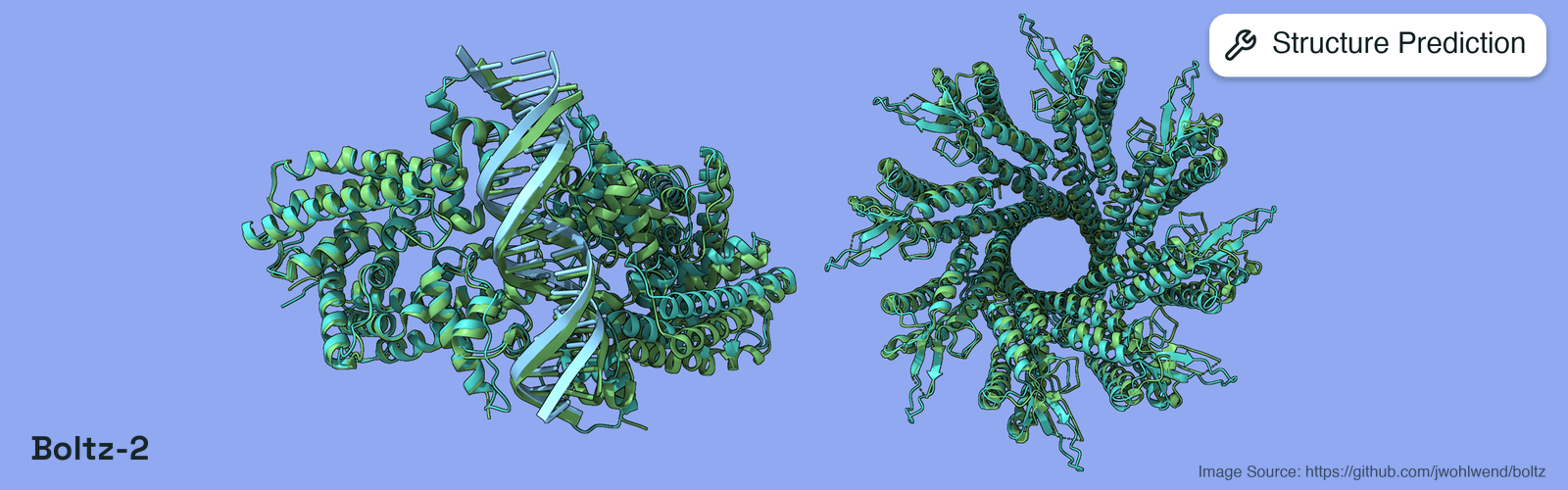
Boltz-2 (Passaro et al., 2025) predicts the joint 3D structure of a biomolecular assembly from the sequences and chemical components it contains. It builds on Boltz-1, one of the most widely used open-source alternatives to AlphaFold3, extending that co-folding model with a binding-affinity module, improved controllability, and additional training data. Like AlphaFold3, a single model folds complexes that mix proteins, DNA, RNA, and small-molecule ligands and predicts how those components are arranged relative to one another. Each protein chain can be paired with a multiple-sequence alignment (MSA) of evolutionarily related sequences, whose covariation patterns supply the evolutionary signal the model uses to place residues. Architecturally, Boltz-2 reproduces AlphaFold3: it carries a single representation of the input tokens and a pairwise representation over token pairs, refines them through an AlphaFold3-style trunk, and generates all-atom coordinates with a diffusion module that starts from noise and iteratively denoises into a structure. Several structures can be sampled per complex and ranked by a confidence score, reported as a complex predicted local distance difference test (pLDDT) for local reliability, a predicted aligned error (PAE) for the relative placement of any two tokens, and predicted template-modeling (pTM) and interface predicted template-modeling (ipTM) scores that summarize overall and interface accuracy. Beyond structure, Boltz-2 adds a binding-affinity module that approaches the accuracy of physics-based free-energy perturbation while running more than 1000 times faster. The reference implementation is open-sourced at jwohlwend/boltz under the MIT license, covering the code, weights, and training pipeline for both academic and commercial use, with the released weights distributed asboltz-community/boltz-2. It was developed by the Boltz team at the MIT Jameel Clinic together with Recursion.
Learning Resources
- Boltz-2: democratizing biomolecular interaction modeling (MIT Jameel Clinic and Recursion) - an accessible overview of Boltz-2, including how it extends on the work of Boltz-1 and its binding-affinity capability.
Tools
Boltz-2 Structure Prediction (boltz2-prediction)
Predicts the 3D structure of a biomolecular complex. Each input complex can combine protein, DNA, RNA, and ligand chains; the assembly is folded by Boltz-2 and returned as a predicted Structure per complex with confidence metrics: a complex pLDDT, pTM, interface pTM, per-chain and pairwise-chain pTM/ipTM, and predicted aligned error.API Reference
Source
Input: Boltz2Input
Input: Boltz2Input
List[Complex]
required
List of complexes to predict structures for. Inherited from
StructurePredictionInput. Each complex can contain multiple chains of proteins, DNA, RNA, and/or ligands.array
Pre-computed MSAs, one entry per complex. Each entry is a
ComplexMSAs (per-chain MSAs keyed by chain index); paired=True marks rows taxonomy-aligned across chains. Populated by preprocess() or supplied directly. Source
Config: Boltz2Config
Config: Boltz2Config
integer
default:"3"
Iterative refinement passes through the model. Higher = more accurate but slower. Default 3 (matches upstream).
integer
default:"200"
Denoising steps in the diffusion process. Higher = more refined but slower. Default 200 (matches upstream).
integer
default:"1"
Independent structure samples per complex; the best by confidence is returned. Default 1 (matches upstream).
number
default:"1.5"
Diffusion step size (typical range 1.0-2.0). Lower = more sample diversity. Default 1.5 (matches upstream).
integer
default:"8192"
Maximum number of MSA sequences fed into the model. Lower to reduce GPU memory on deep MSAs. Default 8192.
boolean
default:"False"
Randomly subsample the MSA on each run for sample diversity (loses determinism). Default False.
integer
default:"2"
Number of dataloader workers for prediction. Automatically set to the minimum of available CPU cores or 4. Must be at least 1. Default:
min(cpu_count, 4).integer
default:"0"
Whether to print status messages during execution including MSA generation, model loading, and prediction progress. Inherited from
StructurePredictionConfig. Default: False.string
default:"cuda"
Device to run the model on. Options include
"cuda" (NVIDIA GPU), "cpu" (CPU execution), or specific GPU devices like "cuda:0". Structure prediction is computationally intensive and strongly benefits from GPU acceleration. Default: "cuda".integer
default:"1200"
Maximum execution time in seconds.
None waits indefinitely. Default: 1200.integer
Random seed. When set, tools run reproducibly up to small GPU float noise (see
BaseToolOutput.approx_equal), and the seed participates in cache keys. When None, cacheable seed-sensitive tools skip cache until seeded.boolean
default:"False"
Attach
pae (avg_pae always emitted). Default: False.boolean
default:"True"
Whether to generate and use Multiple Sequence Alignments (MSAs) for protein chains using MMseqs2 homology search. Supplied MSAs are always used and override
use_msa=False. Inherited from MSAStructurePredictionConfig. Default: True.Mmseqs2HomologySearchConfig
Configuration for MMseqs2 homology search (MSA generation). Only used when
use_msa=True. Inherited from MSAStructurePredictionConfig. Default: None.boolean
default:"True"
Whether heterocomplex protein chains should use taxonomy-paired MSA generation. Inherited from
MSAStructurePredictionConfig. Default: True. Source
Metrics (one set per
Output: Boltz2Output
Output: Boltz2Output
List[Structure]
required
Predicted structures, each carrying a :class:
Boltz2Metrics instance on .metrics.structures item)Applications
This tool predicts the structure of multi-component assemblies such as protein-DNA and protein-RNA complexes or protein-ligand binding poses. Running it on a multi-chain complex also estimates how confidently the components are placed relative to each other through interface pTM and PAE, which is informative for assessing predicted interfaces.Usage Tips
use_msadefaults toTrue. A ColabFold search generates an MSA for each protein chain; set itFalsefor single-sequence prediction, or attach precomputed MSAs to the input. Protein chains with no detectable homologs fall back to an empty MSA.- Structures come from a diffusion process.
diffusion_samples(default1) independent samples are drawn per complex and the best is kept byconfidence_score;sampling_steps(default200) sets the number of denoising steps andstep_scale(default1.5) trades accuracy for sample diversity, where lower values are more diverse. recycling_steps(default3) trades accuracy for time. More recycling iterations refine the prediction but increase runtime.- Confidence is reported as a complex pLDDT, pTM, ipTM, and PAE.
confidence_score, the primary metric, isiptmfor multi-chain complexes andptmfor a single chain;complex_plddtis on a 0 to 1 scale and PAE is in angstroms (0 to about 32). Setinclude_pae_matrixto attach the full per-token PAE matrix. - Multi-modal inputs. Protein, DNA, RNA, and ligand entities are supported; chain modifications are not.
Boltz-2 Affinity (boltz2-affinity)
Predicts the binding affinity of a single small-molecule ligand against a protein target. Each input complex must contain at least one protein chain and at least one ligand chain; the binder is the complex’s sole ligand (auto-detected) or the chain named by binder_chain. Each complex returns a predicted Structure with the binding pose in the CIF and the affinity scores on structure.metrics: affinity_pred_value (log10 IC50 in μM; lower is stronger binding) and affinity_probability_binary (binder probability in [0, 1]).API Reference
Source
Input: Boltz2AffinityInput
Input: Boltz2AffinityInput
array
Ligand to score per complex; one value broadcasts to all complexes, None auto-detects each complex’s sole ligand.
List[Complex]
required
Each needs >=1 protein target and >=1 ligand chain.
array
Inherited per-complex MSAs; each entry is a
ComplexMSAs (paired=True for taxonomy-paired heterocomplexes). Source
Config: Boltz2AffinityConfig
Config: Boltz2AffinityConfig
boolean
default:"False"
Apply molecular-weight correction to the affinity value head. Default:
False.integer
default:"200"
Denoising steps for the affinity pass. Default:
200.integer
default:"5"
Diffusion samples per complex for the affinity pass. Default:
5.integer
default:"0"
Whether to print status messages during execution including MSA generation, model loading, and prediction progress. Inherited from
StructurePredictionConfig. Default: False.string
default:"cuda"
Device to run the model on. Options include
"cuda" (NVIDIA GPU), "cpu" (CPU execution), or specific GPU devices like "cuda:0". Structure prediction is computationally intensive and strongly benefits from GPU acceleration. Default: "cuda".integer
default:"1200"
Maximum execution time in seconds.
None waits indefinitely. Default: 1200.integer
Random seed. When set, tools run reproducibly up to small GPU float noise (see
BaseToolOutput.approx_equal), and the seed participates in cache keys. When None, cacheable seed-sensitive tools skip cache until seeded.boolean
default:"False"
No-op for affinity; excluded from the cache key. Default:
False.boolean
default:"True"
Inherited. Use MMseqs2 MSAs for protein chains. Supplied MSAs are always used and override
use_msa=False. Default: True.Mmseqs2HomologySearchConfig
Inherited. MMseqs2 homology-search config. Default:
None.boolean
default:"True"
Inherited. Use taxonomy-paired MSA generation for heterocomplex protein chains. Default:
True.integer
default:"3"
Inherited. Refinement passes for the structure pass. Default:
3.integer
default:"200"
Inherited. Denoising steps for the structure pass. Default:
200.integer
default:"1"
Inherited. Structure samples per complex. Default:
1.number
default:"1.5"
Inherited. Diffusion step size for the structure pass. Default:
1.5.integer
default:"8192"
Inherited. Cap on MSA depth fed into the model. Default:
8192.boolean
default:"False"
Inherited. Randomly subsample the MSA each run. Default:
False.integer
default:"2"
Inherited. Dataloader workers for prediction. Default:
min(cpu_count, 4). Source
Metrics (one set per
Output: Boltz2AffinityOutput
Output: Boltz2AffinityOutput
List[Structure]
required
List of predicted structures, one per input complex. Each structure contains the 3D coordinates in CIF format along with model-specific confidence metrics. The order matches the input complexes order.
structures item)Applications
This tool ranks candidate ligands against a chosen protein target, pairing a predicted affinity with a predicted binding pose — supporting hit discovery, structure-activity studies, and library-screening loops over a list of SMILES.Usage Tips
affinity_pred_valueis on a log10-IC50 (μM) scale. Values below0(sub-μM IC50) indicate strong binders; positive values indicate weaker binding.affinity_probability_binaryis an independent binder probability and can stay high even when the IC50 estimate is uncertain.- One binder ligand per complex. The binder is auto-detected when a complex has exactly one ligand; set
binder_chainto name it when a complex has several.binder_chainis per-complex: pass one value (e.g.["B"]) to apply it to every complex, or one per complex (e.g.["B", None], whereNoneauto-detects). The binder must be a ligand chain with at most 128 heavy atoms. - Structure-side and affinity-side settings are independent.
recycling_steps,sampling_steps,diffusion_samples, and MSA settings control the structure pass that runs first;sampling_steps_affinity(default200) anddiffusion_samples_affinity(default5) control the affinity pass. Setaffinity_mw_correctionto apply Boltz-2’s molecular-weight correction to the affinity value head. - Stochastic predictions. The diffusion-based affinity head is stochastic; set
seedfor reproducibility.
Toolkit Notes
These apply to every Boltz-2 tool in this toolkit (boltz2-prediction, boltz2-affinity).
- Requires a GPU. Boltz-2 runs through a PyTorch backend and needs an NVIDIA GPU; CPU execution is not practical.
- MSA-based and AlphaFold3-style. Boltz-2 uses optional MSAs and a diffusion process.
subsample_msaand unseeded runs are intentionally non-deterministic. - Shared model weights. Both tools run the same bundled Boltz-2 checkpoint; the affinity head ships with it, so
boltz2-affinityneeds no extra download or environment.
Infrastructure Guides
The following guides cover how to run tools efficiently and at scale.Tool Persistence
Keep a tool’s model warm across calls instead of reloading it every invocation.
Device Management
How GPUs are allocated to tools and how to target specific devices.
Parallel Execution
Fan a batch of inputs out across multiple GPUs.